
Commercial low-slope roofing only · Family-owned in Indiana, PA · SBA HubZone certified
Mon–Fri 7:00am–5:00pm · 412-888-0283
Your roof is leaking. The first bid says tear it off. Before you sign a six-figure check, there is a question worth asking: is the roof actually failing, or is the surface?
Most commercial low-slope roofs that get torn off did not need to be.
The membrane weathers. Seams open. Fasteners back out. Water finds a path. But underneath, the deck and the insulation are frequently sound — and a sound substrate can be restored with a coating system that carries a manufacturer warranty and buys up to another 10 to 20 years.
ClimaShield Commercial Roofing is a commercial roof coating contractor in Indiana, Pennsylvania. We restore low-slope commercial roofs — no tear-off, no dumpsters, no shutting your building down. And when a roof genuinely is past restoring, we say so and quote the replacement instead.
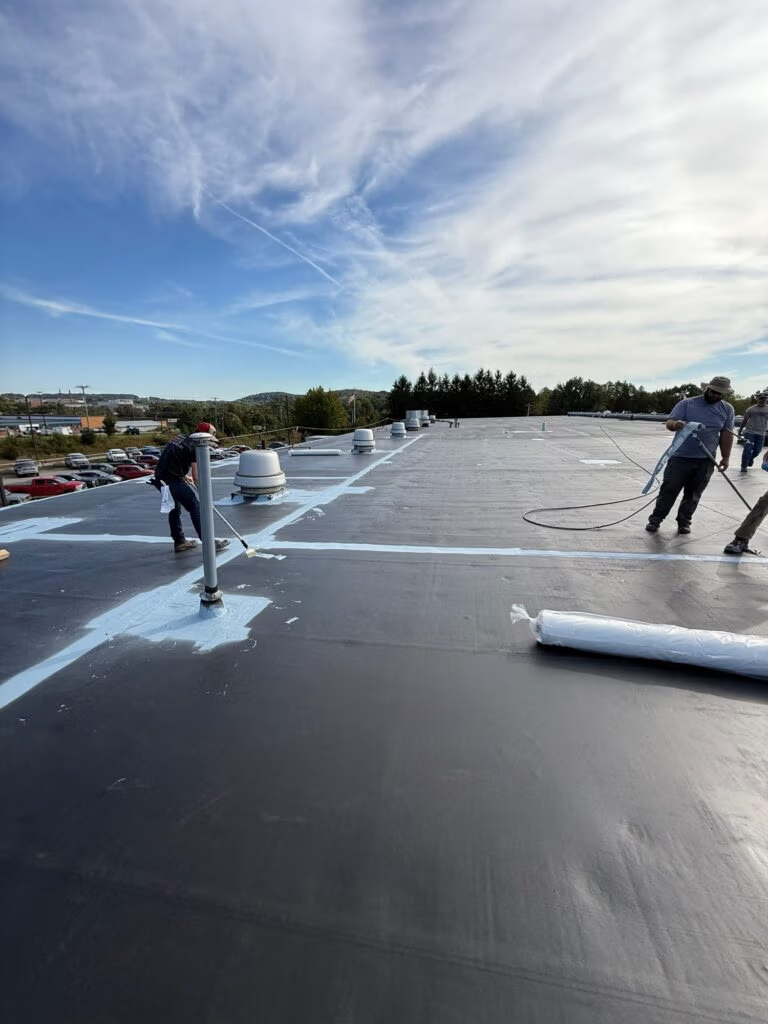
This is the part most building owners do not find out until the change orders arrive.
In Pennsylvania, removing a commercial roof down to the deck generally requires the new assembly to meet current energy-code insulation values. In our climate that lands around R-30 — roughly five inches of insulation, where you may currently have far less.
Five inches usually changes the height of your roof. And a roof at a new height often means:
How much applies depends on the building — the code allows less insulation where existing conditions leave no room for the full thickness. But much of it is often missing from the roofing line of the bid, and arrives afterward. Ask whether it is in the number.
A restoration coating does not trigger any of it. You are not removing the assembly, so the code requirement is not invoked. You keep the insulation you have, the penetrations stay where they are, and the edge metal stays on the building.
That is the real reason restoration costs so much less. It is not a discount. It is an entirely different scope of work.
Ask any contractor bidding you a tear-off: does this price include bringing the assembly to R-30, and does it include re-flashing the penetrations and replacing the edge metal wherever the new height requires it? The answer will tell you what you are actually comparing.
| Restoration coating | Full tear-off and replacement | |
|---|---|---|
| Added insulation required by code | No | Yes — R-30 |
| Penetrations, curbs, edge metal | Stay as-is | Often rebuilt at new height |
| Business disruption | Minimal — you stay open | Significant |
| Landfill waste | None | Entire existing roof |
| Manufacturer warranty | Yes | Yes |
| Recoat at end of warranty | A fraction of the original restoration | Full replacement again |
That last row is the one facility managers care about most. A restored roof is renewable. When the warranty term is up, the surface gets recoated at a fraction of the original cost — because the preparation is already done. A tear-off puts you back at the beginning of the cycle.
Figures reflect published industry and Pennsylvania market ranges. Your building gets a specific number after we inspect it, not a range.
Aged TPO on a large, fully occupied state facility. We restored it with a fabric-reinforced acrylic basecoat and a polyurethane-modified acrylic topcoat — no tear-off, no exposure of the shop below, no interruption to District operations.
Aged black EPDM over motors, transmissions, gearboxes, dynos, and specialty machine tools — equipment you cannot expose to weather and cannot easily move. Same fabric-reinforced system, same result: restored in place.
A tear-off here would likely also have triggered the R-30 cascade across 60,000 square feet — new insulation, and with it penetrations, curbs and edge metal raised to suit.


A standing-seam metal roof over an ice facility. We applied a corrosion primer, sealed every standing seam and lap with commercial-grade flowable roof caulk, and coated the roof in a highly reflective solar-radiance white elastomeric acrylic.
Interior temperature dropped 20°F.
The rink can now make ice through August and September — months it previously could not operate in. That is not a roofing outcome. That is operating revenue the building did not have before.

This is the part that changes how a roof sits in a capital plan, and it is worth understanding before you decide anything.
A tear-off restarts the clock. You buy a new roof, it ages for twenty years, and then you buy another new roof. Every cycle is a full capital expense, and every cycle brings the same disruption, the same demolition, and — under current code — the same insulation cascade.
A restoration does not work that way. The preparation is the expensive part: cleaning, repairing details, treating seams and terminations, building the reinforced membrane. Once that is done, it stays done. At the end of the warranty term the roof is cleaned and recoated for a fraction of the original restoration cost, because nobody is repeating the preparation.
Then it is renewed again at the end of the next term.
Done on schedule, a restored roof does not have a natural end of life the way a membrane roof does. It has a maintenance cycle. The roof stops being a recurring capital project and becomes a managed asset with a predictable annual cost — which is a materially easier conversation with a board, a CFO or a capital committee than “we need another roof.”
The condition for all of it is that somebody keeps the roof on a schedule. A coating is a wearing surface; an owner who will not recoat on time will get more predictable results from a membrane.
If a contractor only sells one system, every roof needs that system. We chose not to work that way.
We are manufacturer-trained across multiple roofing systems and technologies, including:
| Manufacturer | What we use it for |
|---|---|
| Conklin | Full roofing line — fabric-reinforced systems, metal restoration, membrane coating, Affinity urethane coatings, and Flexion 60 mil PVC membrane for replacement |
| Carlisle | Sure-Flex and FleeceBACK PVC single-ply membranes for replacement and recover, and ProDeq / PumaDeq walkable deck systems |
| PPG / VersaFlex | Polyurea coatings for the toughest exposures |
| Castagra | A narrow specialist line — see below |
Castagra — a specialist coating, not a default. Castagra makes plant-based, solvent-free coating systems for chemically aggressive environments and for details that take more abuse than the field of the roof. We do not put it on whole buildings as a matter of course; we specify it where the conditions call for it. At Audiological & Speech Associates, the main roof — an aged asphaltic membrane — received BASF spray foam and an acrylic system, but the roof troughs against the facade, where water drains and sits longest, got a Castagra two-component coating instead. That is what it is for: the specific area where a standard coating would be the weak point. It also suits drainage troughs, scuppers and low spots, aggressive industrial atmospheres, and occupied buildings where a solvent-free system is preferred. On most roofs those conditions do not exist — and saying so is the point of carrying more than one line.
Your roof gets the system that fits its substrate, its exposure, and its remaining service life. Not the system we happen to stock.
(We also install BASF spray polyurethane foam roofing systems where a foam roof is the right answer — see Spray Foam Roofing. The four above are the coating and membrane lines.)
A note on how we came to this. ClimaShield was founded from two directions — 17 years inside PPG in coatings chemistry, safety engineering and national sales management, and more than 35 years of general contracting. We came to roofing from the coatings side, which is why we lead with restoration and why we care which product goes on which substrate — and we have the construction side, which is why we will also tell you when a roof has to come off. This is a family-owned company in Indiana, Pennsylvania.
Fabric-Reinforced Systems — A reinforcing fabric embedded in an acrylic basecoat, then top-coated. The fabric bridges seams, splits and stress points and gives the system real tensile strength. This is what went on PennDOT and Cleveland Brothers, and it works over both TPO and EPDM.
→ Fabric-Reinforced Roofing
Elastomeric Acrylic Coatings — Highly reflective, flexible, and the workhorse of commercial restoration. Reflectivity is not a brochure claim — see the 20°F drop at S&T.
Metal Roof Restoration — Metal roofs almost never fail in the panel. They fail at fasteners, seams and laps. We prime for corrosion, seal the details, and coat the whole surface.
→ Metal Roof Restoration

Membrane Coating and Recover — Restoring aged EPDM, TPO and asphaltic membranes in place.
→ Membrane coating or recover — see below
Conklin Affinity — Single-Component Aliphatic Polyurethane — A one-part aliphatic polyurethane coating that goes over metal, concrete, spray foam and approved membranes, with a white reflective finish. Single-component means no field mixing and no ratio errors — one less way an installation goes wrong.
Polyurethane-Modified Acrylic Topcoats — Higher abrasion and ponding resistance where the roof takes traffic or holds water. This is the topcoat over the fabric-reinforced basecoat on PennDOT and Cleveland Brothers.
Polyurea Coatings (VersaFlex) — Fast-set, extremely tough, for the hardest service conditions.
Castagra Systems — Plant-based, solvent-free coatings for chemically aggressive environments and drainage areas — specified where the conditions call for it (see above).
Aged single-ply looks worse than it usually is. The surface chalks, seams open, terminations pull, and the whole roof reads as failed — while underneath, the deck and insulation are frequently dry and entirely serviceable.
What we have restored, and over what:
Coating or recover — the two middle paths between “patch it” and “tear it off”:
Which one applies depends on the condition of what is already there, how many roof layers the building already carries, and — for a recover — what your local code official says about your building. Neither is possible if the insulation is wet, which is why we survey before recommending anything.
Restoration is not the answer when the insulation is saturated, when the deck is compromised, or when the existing membrane has failed beyond what a coating can bridge.
We find that out before we quote, not after. An inspection includes a walk of the full roof, evaluation of seams, terminations, penetrations and drainage, and — where moisture is suspected — an infrared survey that shows trapped saturation a visual walk cannot see.

If your roof does not qualify, we will tell you, and we will quote the replacement — Conklin Flexion 60 mil PVC or a spray foam roofing system. We would rather lose a coating job than sell you one that fails, and we tear roofs off and rebuild decks when that is the honest answer. We do complete tear-offs and new construction across every system we offer — single-ply TPO and PVC, coatings, spray foam roofing and metal.
ClimaShield Commercial Roofing is based in Indiana, Pennsylvania and works across Western and Central Pennsylvania, plus Ohio, West Virginia and Maryland.
That covers Indiana County, Cambria, Jefferson, Westmoreland, Blair, Clearfield, Armstrong and Somerset counties and reaches Pittsburgh, Johnstown, Altoona, State College, DuBois, Punxsutawney, Greensburg, Ebensburg and Somerset — and across the state lines into Ohio, West Virginia and Maryland.
If you are not sure whether your building falls inside it, call and ask. It usually does.
We will inspect your roof, document its condition, and tell you plainly whether it should be restored or replaced. No obligation, and you keep the report either way.
Restoring a commercial roof means renewing the existing roof in place rather than removing and replacing it. The roof is inspected and surveyed for trapped moisture, cleaned and prepared, failed details and seams are repaired, and a coating system — often reinforced with an embedded fabric — is applied over the whole surface to form a new membrane. The result carries a manufacturer warranty and typically costs far less than a tear-off replacement, because the existing assembly, penetrations, curbs and edge metal all stay in place.
A coating is the material; restoration is the process. A restoration includes the survey, the preparation, the detail and seam repairs and the coating system together — and it is that preparation, not the coating itself, that determines whether the roof lasts. Coating a roof that has not been properly prepared, or one with saturated insulation underneath, is not a restoration; it is paint over a problem.
Professional-grade commercial coating systems typically last 10–20 years when they are applied correctly over a properly prepared substrate. Manufacturer warranties are available, and the system can be recoated at the end of the term for a fraction of the original restoration cost.
In Pennsylvania, usually yes. Removing a commercial roof down to the deck generally requires the new assembly to meet current energy-code insulation values — around R-30 in our climate. That usually means adding roughly five inches of insulation, and often reworking penetrations, curbs and edge details to the new roof height (the code allows less insulation where existing conditions leave no room). A restoration coating does not trigger the requirement, because the assembly is not being removed. Your local code official confirms the specifics for your building.
It depends on the substrate, its condition and the system specified, so we price each roof after we inspect it. As a rule, restoration costs far less than a full tear-off and replacement, and at the end of the warranty term the surface can be recoated for a fraction of the original restoration cost.
Yes. We have restored both. PennDOT District 10 was aged TPO; the Cleveland Brothers machine shop was aged black EPDM. Both used a fabric-reinforced acrylic system.
Coating renews the existing membrane in place. Recover installs a new membrane over the existing roof without removing it. Both avoid a tear-off; which is appropriate depends on the roof’s condition, how many layers the building already carries, and what your local code official requires.
It can, substantially. On the S&T Bank Arena, a highly reflective white elastomeric acrylic coating dropped the interior temperature by 20°F — enough that the facility can now make ice in August and September.
Then we tell you, and we quote a replacement instead — PVC, TPO or spray foam. Roofs with saturated insulation or a compromised deck are not restoration candidates, and an infrared survey identifies that before anyone commits.
Yes. ClimaShield Commercial Roofing works exclusively on commercial low-slope roofs. We do not do residential or shingle roofing.