
Commercial low-slope roofing only · Family-owned in Indiana, PA · SBA HubZone certified
Mon–Fri 7:00am–5:00pm · 412-888-0283
Maintenance program customers: we are on your roof within 24 hours — weekends and holidays included. That commitment is one of the reasons the program exists. → Roof Maintenance Programs
Commercial low-slope roofs · Western and Central Pennsylvania, plus Ohio, West Virginia and Maryland · Roofs we installed and roofs we didn’t
1. Protect what’s underneath. Move equipment, inventory, records and electronics out from under the leak, or cover them. Water damage to contents usually costs more than the roof repair.
2. Catch and contain the water where you safely can. A drum and a tarp beat a ruined floor.
3. Do not send anyone onto the roof. A wet low-slope roof is genuinely dangerous, and foot traffic during an active leak frequently makes the damage worse. It can also complicate a warranty claim.
4. Photograph everything — the interior stain, the dripping point, the damaged contents, the time and date. If this becomes an insurance or warranty claim, these photographs are worth more than anything you can write down afterward.
5. Note exactly where water enters the building — which room, which bay, how far from an outside wall, near what equipment. This is the single most useful thing you can tell us on the phone.
6. If it is safe and accessible from the ground, check whether your drains are clear. Blocked drains and scuppers cause a startling share of “sudden” roof leaks, and it is the one thing you can sometimes fix yourself.
This is the part that costs building owners the most money, because it is the reason so many “repairs” don’t work.
Water enters the roof at one point, then travels — along the underside of the membrane, across the top of the deck, down a slope you cannot see, along a deck flute, over a beam — before it finds an opening and comes through the ceiling somewhere else entirely. On a large low-slope roof, the entry point can be a considerable distance from where you are standing with a bucket.
Which means patching the spot above the stain frequently fixes nothing. The water stops for a week, the next storm comes, and it returns — sometimes in a new place, which is how one leak turns into a building owner who believes the whole roof is failing when it isn’t.
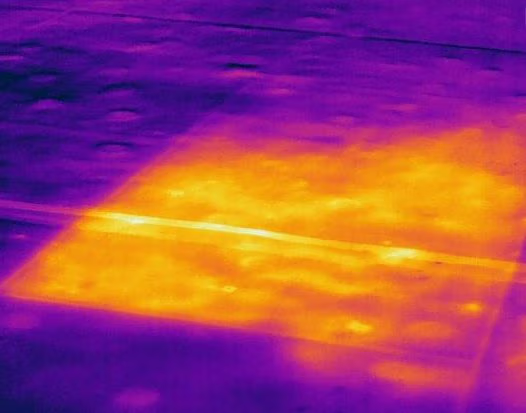
Finding the actual entry point is diagnostic work: tracing the path back, examining the details upslope, and where the source isn’t obvious, an infrared survey to map where moisture is actually sitting inside the assembly.


If your roof is under a manufacturer warranty, a repair by an unapproved contractor can void your coverage — on the entire roof, not just the patched area. So can the wrong sealant.
This is not a technicality that gets overlooked. Manufacturers specify who may work on a warranted system and what materials may touch it, and an unauthorized repair is treated as an alteration.
We have seen the shape of this problem time and again: water comes through on a Friday, somebody available shows up with a bucket of whatever is in the truck, the leak stops — and the coverage on a roof with twelve years left on its warranty is gone. The owner finds out years later, when they file a claim for something else entirely.
Two questions worth thirty seconds before you authorize any emergency repair:
We install and maintain Conklin, Carlisle, PPG/VersaFlex, Castagra and BASF systems, and we will tell you honestly if your roof is under a warranty we cannot service — in which case the right move is calling the manufacturer for an approved contractor, not letting us patch it.
Low-slope roofs rarely fail in the middle of the field. They fail where the roof meets something else.
Seams and laps — the first place age shows on single-ply membrane, and the most common source of an active leak.
Penetrations — every pipe, vent, drain, conduit and equipment mount, and the flashing at each one. Anything added after the original roof went on is a prime suspect.
Curbs and rooftop equipment — HVAC units, exhaust fans, skylights. When another trade sets equipment and flashes it themselves, this is where it shows up.
Roof-to-wall transitions and parapets — the highest-value detail on most buildings, and the most commonly neglected.
Drains and scuppers — blocked drainage backs water up against details never designed to be submerged.
Edge metal and copings — often wind-related, often after a storm.
Punctures from traffic — dropped tools, dragged equipment, and people walking a roof that was not designed to be walked on.
We repair leaks, and often that is the whole job — a failed detail on an otherwise sound roof, fixed, done, and you should not be sold anything else.
But if you are on your third or fourth leak in two years, the roof is telling you something, and continuing to buy repairs is the most expensive way to respond to it.
That is the point to find out what condition the assembly is actually in — specifically whether the insulation is dry. It determines everything:
We will tell you which one you have, in writing, and we will tell you when the honest answer is “keep repairing it, it’s fine.”
We will take your call either way. But we are honest about what we can promise a stranger versus what we can promise a building we already know.
If your building is on a ClimaShield maintenance program, we are on your roof within 24 hours of your call — weekends and holidays included.
That is not a marketing line — it is possible because of what the program already gives us. We know the building. We know what system is on it, how old it is, where it has given trouble before, and how to get onto the roof. We have your file, your drawings and your photographs from the last inspection. There is no discovery phase, no “we’ll get someone out to look and then schedule the work.”
If your building is not on a program, we will still come, and we will still tell you the truth about what we find. We just cannot put a clock on it the way we can for an account we already carry.
That difference is one of the reasons the program exists — and if you are reading this page because you are currently standing under a leak, it is worth remembering when the water stops.
Every repair we perform is documented — what we found, what caused it, what we did, with photographs and a date.
That record matters in three places: a manufacturer warranty claim, an insurance claim, and the maintenance file that keeps your warranty in force in the first place. A repair nobody documented is a repair that did not happen, as far as any of those three are concerned.
You do not have to be a customer. We repair commercial low-slope roofs from any manufacturer, installed by anyone.
From our base in Indiana, Pennsylvania, we work across Western and Central Pennsylvania, plus Ohio, West Virginia and Maryland — including Pittsburgh, Johnstown, Altoona, State College, DuBois, Punxsutawney, Greensburg, Ebensburg and Somerset.
The buildings we work on include PennDOT District 10, the Cleveland Brothers Caterpillar machine shop, the S&T Bank Arena, Indiana Area School District and Chemstream — occupied, working facilities that cannot simply close because the roof is leaking.
Tell us where the water is coming in and what kind of building it is. If it is actively coming through, call rather than fill out a form.
Because water travels. It enters the roof at one point, then moves along the underside of the membrane, across the deck, or down a slope you cannot see before finding an opening and coming through the ceiling somewhere else. On a large low-slope roof the entry point can be a long way from the stain, which is why patching directly above the drip so often fails to stop it.
Yes. Most manufacturer warranties require that repairs be performed by a contractor the manufacturer has approved for that system, using approved materials. A repair by an unapproved contractor, or with the wrong sealant, can void coverage on the entire roof — not just the repaired area. Check whether your roof is under warranty before authorizing an emergency repair, not after.
No. A wet low-slope roof is dangerous, foot traffic during an active leak often worsens the damage, and damage caused by walking on the roof is generally excluded from warranty coverage. Photograph the interior, note exactly where water is entering the building, and let a roofing contractor go up.
Yes, on commercial low-slope roofs from any manufacturer. If your roof is under a manufacturer warranty we are not approved to service, we will tell you that rather than patch it and cost you the coverage.
It depends on one thing above all others: whether the insulation is dry. A roof with dry insulation and a sound deck can usually be repaired, and often restored in place with a coating system for far less than replacement. A roof with widespread saturated insulation is not a repair candidate — money spent patching it is money into an assembly that is already gone. An infrared moisture survey answers this.
Move or cover anything valuable under the leak, contain the water where you safely can, photograph the damage and the time, note exactly where water is entering the building, and stay off the roof. If your drains are visible and reachable from the ground, check whether they are blocked.
If your building is on a ClimaShield maintenance program, we are on your roof within 24 hours of your call, weekends and holidays included — we already know the building, the system on it, and how to access it, so there is no discovery phase. If you are not on a program we will still respond and still come out, but we cannot commit to a fixed window for a building we have not seen.
Yes, when weather or access makes a permanent repair impossible that day — with the clear understanding that it is temporary and what the permanent fix requires. We will tell you which one you are getting.