
Commercial low-slope roofing only · Family-owned in Indiana, PA · SBA HubZone certified
Mon–Fri 7:00am–5:00pm · 412-888-0283
Every commercial roof fails in the same order: a small detail opens, water gets in, and nobody sees it for two years. A maintenance program is how you find it in month three instead.
A commercial roof is the only major building system most owners operate with no scheduled service at all.
You service the HVAC. You inspect the fire suppression. You have somebody looking at the elevator. The roof — a six-figure asset protecting everything underneath it — gets attention the day it leaks, and not before.
That is expensive in a specific and predictable way. A failed seam caught early is a repair. The same seam found after two winters of saturation is a section of wet insulation, a stained ceiling, and a conversation about whether the roof can still be restored.
A commercial roof maintenance program puts the roof on a schedule: documented inspections at set intervals, drains and details cleared and repaired before the weather tests them, and a written record that satisfies your manufacturer’s warranty requirements.
ClimaShield Commercial Roofing runs maintenance programs on commercial low-slope buildings across Western and Central Pennsylvania, plus Ohio, West Virginia and Maryland — including buildings we did not install.

The economics here are not subtle, and they run the opposite direction from most people’s instinct.
| Proactive maintenance program | Reactive — fix it when it breaks | |
|---|---|---|
| When the work happens | Scheduled, budgeted | Unplanned, on the weather’s schedule |
| What you are paying to fix | The failed detail | The failed detail, plus everything the water reached |
| Effect on roof service life | Extends it | Shortens it |
| Effect on your options | Keeps restoration available | Saturation eventually removes it |
Reacting to leaks costs far more over time than a scheduled program — and that is before counting interior damage, lost inventory, or the disruption of an unplanned repair in an occupied building.
Another way to frame it, and the one that tends to land with a CFO or a capital planner: a maintenance program is a small, predictable line protecting the largest, least predictable expense on the building.
Proactive spending also does something reactive spending cannot: it extends the service life of the roof, which pushes the single largest capital expense on the building further into the future. The National Roofing Contractors Association is direct about this — after correct installation, maintenance is the single most important factor determining how long a roof system lasts and what it costs over its life.
And there is a third cost most owners never count. A roof that has been maintained and documented is a restoration candidate. A roof that has been neglected for eight years frequently is not — once insulation is saturated, coating is off the table and you are buying a replacement. Maintenance is what keeps the cheap option available.
We price programs per building, based on square footage, system type, roof age and condition, and access. Portfolio pricing is available for owners with multiple buildings. You get a specific number after we look at the roof — not a range off a website.
Every ClimaShield maintenance agreement includes these, at every level:
Documented inspection on a set schedule. Written, dated, photographed. Not a verbal “it looks fine.”
Warranty administration. We record the installation completion date for each roof we maintain and schedule your compliance inspection inside the manufacturer’s required window. You do not have to track it. → Roof Warranty Compliance
Drain, scupper and gutter clearing. Blocked drainage is the most common maintenance-neglect exclusion in a roof warranty and one of the most common causes of premature failure. It is also the easiest thing in this entire list to prevent.
Debris removal. Including whatever the last trade left up there.
Minor repairs included. Sealant failures, small punctures, loose terminations, open laps — the things that are cheap in year one and structural in year four. Scope boundaries are defined in your agreement in writing, so there is no argument later about what counted.
Envelope-aware inspection. We inspect the roof and the transitions — roof-to-wall, parapets, terminations, penetrations, curbs, edge metal. Roofs almost never fail in the middle of the field. They fail where the roof meets something else.
A written condition report after every visit. Photographs, findings, work performed, and what we are watching.


Roof cleaning sounds cosmetic. It is not. A commercial roof collects debris, biological growth and airborne soiling continuously, and left alone that does three expensive things: it blocks drainage, it degrades the membrane, and — on a reflective roof — it quietly cancels the benefit you paid for.
Reflective membranes and coatings are specified for solar reflectance; that is the whole point of a white roof. But published manufacturer data shows reflectance falling substantially in the first three years of service — and the mechanism is not the membrane wearing out. It is dirt.
| Membrane | Initial solar reflectance | After 3 years |
|---|---|---|
| Conklin Flexion 2.0 | 0.86 | 0.70 |
| Carlisle FleeceBACK PVC (white) | 0.87 | 0.70 |
Solar Reflective Index falls with it — Flexion from 108 to 84, FleeceBACK from 110 to 86. A roof specified to reflect heat is doing measurably less of it by year three. Cleaning is how you get it back — the cheapest performance work available on a commercial roof.
Reflectance figures: Conklin Flexion 2.0 data sheet and Carlisle FleeceBACK PVC data sheet, CRRC-rated values.
How we clean matters as much as that we clean. Surface washing is done at pressures and with methods the membrane’s manufacturer permits — the wrong pressure or the wrong chemistry damages a membrane, and it is the most common way a well-intentioned cleaning causes a problem. Algae, moss and lichen come off too, because they hold moisture against the membrane. And because somebody competent is on your roof while it happens, anything found is reported in writing.
| Compliance | Preventive | Managed | |
|---|---|---|---|
| Built for | Newer or sound roofs under warranty | Working roofs that need to keep working | Aging roofs, critical operations, multi-building portfolios |
| Documented inspection | Annual | Semi-annual (spring + fall) | Semi-annual |
| Warranty administration | ✔ | ✔ | ✔ |
| Drains, scuppers, debris | ✔ | ✔ | ✔ |
| Minor repairs included | ✔ | ✔ | Expanded allowance |
| Written condition report | ✔ | ✔ | ✔ |
| On your roof within 24 hours of a leak call | ✔ | ✔ | ✔ |
| Annual condition report for capital planning | — | ✔ | ✔ |
| Infrared moisture survey | Included when needed | Included when needed | Scheduled annually, included |
| Multi-year budget forecasting | — | — | ✔ |
Semi-annual is the industry standard cadence — spring and fall — because those are the two moments that matter: after winter has worked the details, and before winter does it again.
Two things every program customer gets, at every level.
We are on your roof within 24 hours of a leak call — weekends and holidays included. We can commit to that because we already know your building: the system on it, its age, its history, and how to get onto it. There is no discovery phase. → Roof Leak Repair
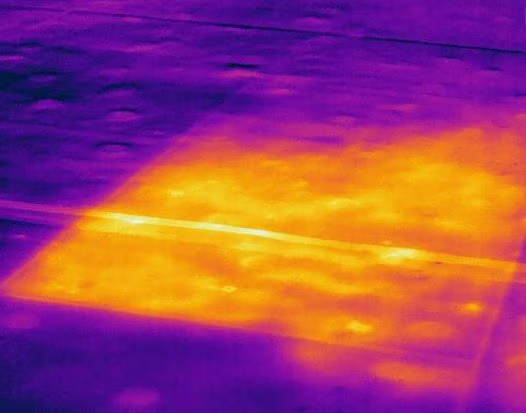
Infrared moisture surveys are included in the maintenance program. Not a line item, not an add-on. If we need to know what is happening inside your assembly, we scan it. On Managed, the survey is scheduled annually as part of the program rather than run on demand.
That second one matters more than it sounds. An infrared survey shows trapped saturation that no visual walk can find, which tells you the one thing that actually decides your next decade of roof spending: whether you are looking at a repair, a restoration, or a replacement. It is evidence rather than opinion, and it usually arrives two to five years before the ceiling tiles do.
The report is not paperwork. It is the document that answers three separate questions, and it is why the program is worth more than the visits.
1. It answers your manufacturer. When a warranty claim is filed, the manufacturer pulls the maintenance records. Your claim is only as strong as your paper trail.
2. It answers your CFO. Every report carries a condition assessment, so the roof stops being an unknown liability in the capital plan and becomes a line with a horizon on it. Facility managers building a five-year budget can point at something.
3. It answers the repair-or-replace question honestly. Our reports use defined thresholds. Sound roof, normal wear — maintain, do nothing else. Localized failures over a sound substrate — that is a restoration coating, at a fraction of replacement cost. Widespread saturation confirmed by infrared — that is a replacement, and we will say so.
We lead with coatings, which means our incentive runs toward finding roofs early enough to restore them. That is the honest version of why this program exists. → Commercial Roof Coatings

The commercial and institutional buildings we work on across Western Pennsylvania include PennDOT District 10, the Cleveland Brothers Caterpillar machine shop, the S&T Bank Arena, Indiana Area School District, IUP off-campus housing, Chemstream, Lezzer Lumber, Tyger Paints and Delaney Chevrolet.
Occupied, working buildings — a state maintenance facility, a machine shop full of dynos and precision equipment, an ice rink that has to hold temperature, a school district that cannot close for a roof.
If you manage a portfolio — a school district, a municipality, a property management company, a manufacturer with several plants — the program is built as one agreement across all of the buildings, with per-building pricing that improves with the count.
That gives you one inspection schedule, one contact, one reporting format, and one consolidated capital-planning picture instead of eight separate roof conversations a year.
You do not have to be an existing customer.
We maintain commercial low-slope roofs from any manufacturer, on buildings installed by anyone. We will tell you what condition the roof is in, what your warranty requires, and whether the roof is worth a program at all — including when the answer is that it is too far gone and you should be planning a replacement instead.
Based in Indiana, Pennsylvania, we work across Western and Central Pennsylvania, plus Ohio, West Virginia and Maryland — including Pittsburgh, Johnstown, Altoona, State College, DuBois, Punxsutawney, Greensburg, Ebensburg and Somerset.
We will inspect the roof, document its condition, tell you what your warranty requires, and propose the program level that fits the building. If the roof does not need a program, we will tell you that too.
Not ready for that? Start smaller: Check Your Warranty Compliance
At minimum: documented inspections on a set schedule, drain and scupper clearing, debris removal, minor repairs, and a written condition report after every visit. ClimaShield programs also include warranty administration — we track your manufacturer’s inspection deadline and schedule the compliance inspection inside the required window. Higher levels add semi-annual inspections, annual capital-planning reports and an infrared moisture survey scheduled every year.
Semi-annual — spring and fall — is the industry standard, and it lines up with when roofs actually take damage: after winter has worked the seams and details, and before winter does it again. Your manufacturer’s warranty may require a specific minimum interval and a specific window, which is a separate requirement from best practice.
Programs are priced per building — square footage, system type, roof age and condition, and access all affect it — and portfolio pricing improves as the building count rises. You get a specific number after we look at the roof.
For most commercial low-slope roofs, yes. Reacting to leaks costs far more over time than scheduled maintenance, because unplanned work is priced differently and the damage has already spread. Maintenance also extends service life, keeps the warranty in force, and — this is the part owners underestimate — keeps restoration coating available as an option. Once insulation is saturated, coating is off the table and the only remaining answer is a full replacement.
Yes. We maintain commercial low-slope roofs regardless of the manufacturer or the original installer.
Yes, and it is measurable. Published manufacturer data shows white membranes falling from roughly 0.86–0.87 initial solar reflectance to around 0.70 within three years, with Solar Reflective Index dropping correspondingly. The membrane has not failed — it is soiled, and cleaning recovers much of the performance.
It is what makes keeping it valid possible. Manufacturers require documented periodic inspections for the life of the warranty, and missing records can void coverage on a roof that is performing fine. Our programs include warranty administration — we track the anniversary date and inspect inside the required window, then document it to the standard a claim requires.
Minor repairs within the scope defined in your agreement are performed as part of the program. Anything larger comes to you as a written recommendation with photographs and a specific proposal — repair, restoration coating, or replacement — with the reasoning for each. We do not perform work outside the agreed scope without your approval.
Yes. Portfolios are written as a single agreement across all buildings, with per-building pricing that improves as the building count rises, one inspection schedule, one contact and one consolidated capital-planning report.