
Commercial low-slope roofing only · Family-owned in Indiana, PA · SBA HubZone certified
Mon–Fri 7:00am–5:00pm · 412-888-0283
A coating spans a crack. A fabric-reinforced system bridges one — and keeps bridging it while the building moves underneath.
Most commercial roof coatings are a liquid applied to a surface. They seal, they reflect, and they buy time. On a sound roof with tight seams, that is often all that is needed.
A fabric-reinforced system is a different thing. A reinforcing fabric is embedded into an acrylic basecoat while it is wet, then locked in with a polyurethane-modified acrylic topcoat. What you end up with is not a coating on a roof — it is a new reinforced membrane, built in place, with actual tensile strength running through it.
That matters because commercial roofs do not fail evenly. They fail at seams, at laps, at splits, at stress points and at every place the building moves. A coating alone spans those. Fabric bridges them, and carries the load across.
Some of our largest restorations are fabric-reinforced — a 60,000 square foot Caterpillar machine shop and a 37,000 square foot state mechanical shop among them. So is a country club that could not close.

It carries tension. Acrylic coatings are flexible but they are not structural. Fabric reinforcement gives the finished membrane real tensile strength, so movement in the roof below is resisted by the fabric rather than absorbed by the coating until it tears.
It bridges what is already open. Seams, laps, splits and stress cracks are the failures a restoration has to solve. The fabric spans them with a continuous reinforced layer, instead of relying on coating thickness alone to hold across a gap that is still moving.
It builds real thickness. Fabric plus basecoat plus topcoat produces a substantially heavier system than a coating alone — which is what gives it the service life to be worth doing on a large industrial roof.
It makes the roof monolithic. Field, seams, details and penetrations end up under one continuous reinforced membrane, rather than a coating over a roof that is still assembled from pieces.

This is the distinction worth understanding before you compare quotes, because two proposals can both say “fabric-reinforced” and mean very different amounts of work.
Detail reinforcement — fabric at the seams, penetrations, curbs and terminations only, with plain coating across the field. This is common, it is legitimate, and on many roofs it is the correct specification.
Full-field reinforcement — fabric embedded across the entire roof surface. Substantially more material and considerably more labour, and it produces a fundamentally stronger membrane.
One is not simply better than the other. They are different specifications for different roofs. A tight roof with localised seam issues may need detail reinforcement and nothing more. A large industrial roof with a heavily worked substrate and equipment traffic is where full-field reinforcement earns its cost.
Ask which one you are being quoted. If two prices are far apart, this is frequently why — and the cheaper one is not necessarily wrong.
A Caterpillar machine shop full of motors, transmissions, gearboxes, dynos and specialty machine tools. Equipment that cannot be exposed to weather and cannot easily be moved.
Fabric-reinforced acrylic basecoat, polyurethane-modified acrylic topcoat. Restored in place — no tear-off, no exposure, and none of the code cascade a full replacement would have triggered across 60,000 square feet.
A state mechanical shop, fully occupied throughout. The same system, with no interruption to District operations. A District shop keeps highway equipment running; it does not have a convenient window in which to be roofless.
A restaurant, grill room, bar, offices and ballroom — under one roof, all of it in use. Same system, tear-off avoided on a building where closing the space is the real cost, not the roofing.
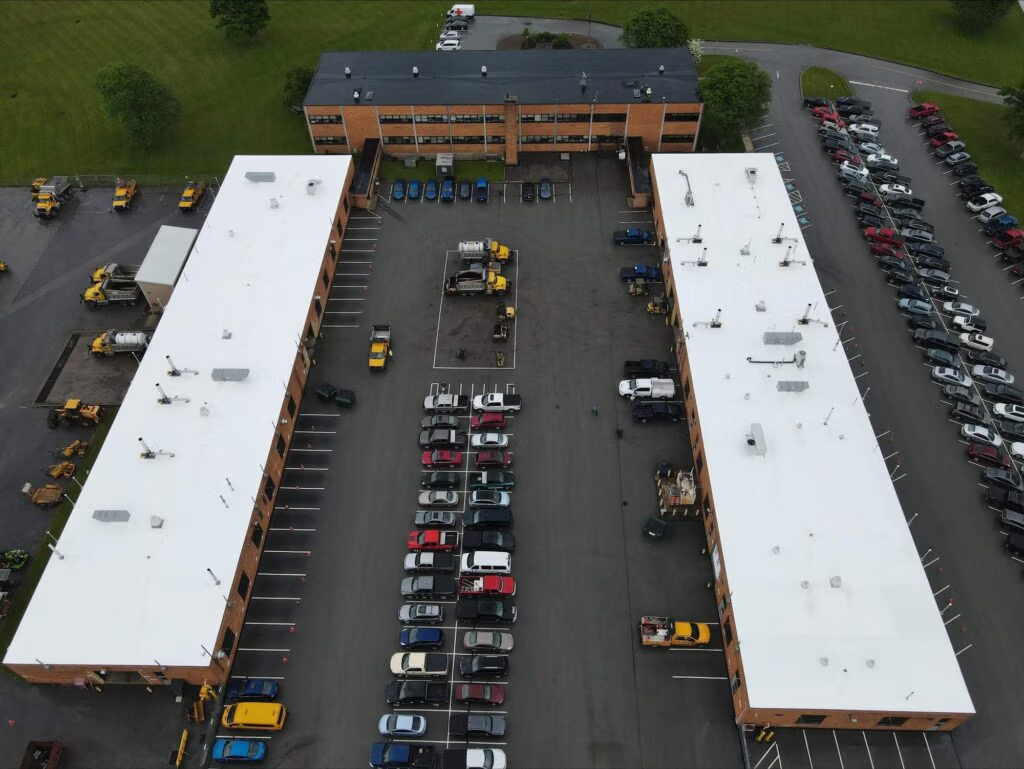


Different substrates, different sectors, one system. Cleveland Brothers proves it over EPDM; PennDOT and Indiana Country Club prove it over TPO. Industrial, government and hospitality. That is the point of a substrate-agnostic system — it is specified for the condition of the roof, not for the brand of membrane somebody installed twenty years ago.
1. Inspect and survey. Full walk of the roof, evaluation of seams, terminations, penetrations and drainage — and an infrared moisture survey where saturation is suspected. If the insulation is wet, this system is not the answer and we will say so.
2. Prepare. Clean the roof properly and repair what needs repairing. Open seams, failed terminations and damaged areas are corrected before anything is coated. Preparation is where restorations succeed or fail.
3. Detail first. Penetrations, curbs, terminations, drains and transitions are treated before the field, because those are where the roof actually leaks.
4. Basecoat and embed the fabric. Acrylic basecoat applied, reinforcing fabric embedded into it while wet, and worked in so it is fully saturated with no voids or bridging.
5. Topcoat. A polyurethane-modified acrylic topcoat over the cured, reinforced basecoat — higher abrasion and ponding resistance than a standard acrylic, which matters on a roof that takes service traffic.
6. Document. Photographed and written, so the record exists for the manufacturer’s warranty file and for you.

Aged single-ply that is weathered but sound. EPDM and TPO that have lost surface integrity while the deck and insulation below are still dry and serviceable — which is the majority of roofs we look at.
Large roofs where tear-off means real disruption. The bigger the building and the more sensitive what is underneath, the more the “no tear-off” argument is worth.
Roofs with a lot of movement. Where seams and stress points keep reopening, reinforcement addresses the cause rather than recoating the symptom.
Roofs that take traffic. Service access, equipment, regular maintenance foot traffic.
When the insulation is saturated. Nothing bonds, nothing lasts, and the water stays. This disqualifies more roofs than anything else, and it is why we survey first.
When the deck is compromised. A membrane is not structure.
When the substrate is too far gone to bond to. There is a point where a membrane has shrunk, split and degraded beyond what reinforcement can rescue.
When the roof genuinely needs a different system — a PVC membrane for chemical or fire exposure, or spray foam where insulation has to be added.
We tear off and replace, and build new, across every system we offer — single-ply TPO and PVC, coatings, spray foam roofing and metal. So when restoration is the wrong answer, you do not need a different contractor.
From our base in Indiana, Pennsylvania, we work across Western and Central Pennsylvania, plus Ohio, West Virginia and Maryland — including Pittsburgh, Johnstown, Altoona, State College, DuBois, Punxsutawney, Greensburg, Ebensburg and Somerset.
We will inspect it, survey it for trapped moisture, and tell you plainly whether a fabric-reinforced system fits — including when it does not.
A restoration system in which a reinforcing fabric is embedded into an acrylic basecoat while it is still wet, then sealed with a polyurethane-modified acrylic topcoat. The result is a reinforced membrane built in place over the existing roof, with tensile strength running through it — as opposed to a coating applied to a surface.
A coating seals and reflects but has no structural reinforcement. Fabric-reinforced systems carry tensile load, so they bridge seams, laps, splits and stress points that are still moving rather than simply spanning them. They are also substantially thicker, which is what gives them the service life to be worth doing on large commercial roofs.
Yes, both — provided the substrate is sound, dry and properly prepared. We restored a 60,000 square foot Caterpillar machine shop over aged black EPDM, and a 37,000 square foot state mechanical shop plus a country club over aged TPO, all with the same system.
Both specifications exist and they are genuinely different amounts of work. Detail reinforcement covers seams, penetrations, curbs and terminations with plain coating across the field. Full-field reinforcement embeds fabric across the entire roof surface. Which is right depends on the condition of your roof — and it is worth asking any contractor which one their price includes, because it is often the reason two quotes differ sharply.
Usually, yes. There is no demolition phase and no period where the building is open to weather, which is the whole advantage. PennDOT District 10 was restored with no interruption to District operations, and Indiana Country Club stayed in use throughout.
Yes. Manufacturer material warranties on fabric-reinforced systems run up to 20 years depending on which coating system is specified, with terms set per project rather than automatic.
The roof is cleaned and recoated rather than torn off — typically for a fraction of the original restoration cost, because the preparation and the reinforcement are already in place. That is what makes a restored roof renewable and a replaced roof a repeating capital expense.